Pipes, wooden, rounded and extending from the dark labyrinths of the sanctum to a place, yet unsuccessfully defined by the humans. Pipes divided into categories of flue and reed, yet necessary to produce the “speak” of place still undefined by the tongues of this terrestrial species. Pipes congregated into ranks, yet necessary to accommodate the whole scale. Pipes, robust, voiced by the supreme builder, working in tandem with the keys and stops, yet surviving the violent roars and swooshes of the simple air.
Just as I was removing the dust which had settled so heavily on one of the organ’s tracker rods, Rudolph jokingly said,’ Robert! I hope you don’t pull out all the stops!’ Rudolph, the actual mechanic responsible for this job to clean the rods and pipes was eating sandwich, while I was toiling with tools which weren’t too familiar to me. I knew he was making sure that I missed this old, dusty and mold infested place. I was about to leave the job of a church organ player in a few days and move on to better pastures. Pastures which were more modern, well-paying and more importantly closer towards Hope.
‘Ruddy, I am telling you, there’s nothing to work here for. We play every Sunday for the church choir and what do we get? Plus, these old systems of keys and stops are too mechanical. We need something robust like the ones in city.’ Just then a spider’s web caught my eye hanging from one of the tracker rods. I wondered whether someone or I, had ever pressed that key or used this set of trackers to get a sound. The tediousness of mechanisms, the friction in the rods, the lack of grease in the trackers and the ill maintained condition of the pipes were some of the things which highlighted my indignation with the church’s method of working. I looked at Rudolph, eating his sandwich with a visible belly bedecking his body. Had he entered a state of stasis just like the place I worked at? It was just a matter of time. I smiled with the parsimonious use of facial muscles just as larger corporations had made these places, once considered to be puritanical and now rather visited by hubris than hands. But I had to finish cleaning up before meeting her.
A couple of days later, I met Hope in the evening after finishing the work at church.
‘Seriously, do you want to walk all the way from the church to your house?’
Yes. The weather is pleasant, and I can get more time to talk with you. You have been working for the last two days cleaning up things in the church with Rudolph and you are leaving soon. So, let’s talk.’
‘I still can’t understand why you want to walk. We can sit and talk.’
‘Robert, you really don’t understand the sentiment behind a lot of things.’
‘Yes, just a lack of words.’
She looked at me with a sneer and said,’ Words? That’s incorrect. You are not prudent with words. You use them a lot, but I feel you don’t understand your emotions. For instance, you are moving to New York, a new city with new people, new house, new opportunities and you don’t sound as exciting as one should be. Oh God! I am excited to have you there more than you are right now!’
‘I got a good deal with the Wallace theater. They are opening a new section in their theatre and I get to work on the organ there. Good food, good money.’
‘Just for the money?’, she looked puzzled.
‘Rhetorical’, I said.
‘Robert, the world they want you in seems fancy, enveloped in gold but it is not all money or fame. There’s hope in there. There’s music in there too.’
I started walking quickly as I didn’t want to extend this conversation. I chuckled, ‘Music is there, for sure.’ I decided I would just give her my one-word answers until we reached her house.
‘Do you know what your first movie for the job will be?’
‘Dumbo.’
‘Is that an answer to my question?’
‘Yes.’
‘Do you have other organ players working with you?’
‘I don’t know.’
For a couple of minutes, I didn’t even realize that she wasn’t asking anything. I looked back and saw that she had stopped walking and was looking at me furiously. I went back and held her hand and asked her what the matter was.
‘Rat-a-tat. Is that the way our walk was supposed to be? It was supposed to be calm, happy and warm. You turned it into one of your dissonant pieces with those minor seconds, minor sevenths and those vexatious notes you harangue me with. I believe you are genuinely talented, and you deserve to be in a better place. But you need to resolve these dissonances within you. You tap too hard, tap too lightly at times and yet there’s music in whatever you do. There’s a strong yardstick in you, unable to flex, unable to compromise but you somehow tend to generate emotion around you. There are waves around you, ready to be disturbed. There are keys below your fingers, ready to be pressed. But all you need is a little bit of faith in the magic that sprinkles from your hands. There are violent swooshes and roars and yet there’s Hope beside you.’
I could not figure out how she could memorize the dissonant chords I taught her once while we were playing with the church organ.
A week later, as I was travelling by train to New York, I thought of Ma. ‘Robert, there’s violence in the world but you don’t have to worry. There will always be a dove descending when you play music and you will find your friend.’
Pipes, wooden, rounded and extending from dark labyrinths, yet invisible to the audience. Pipes assembled with their unique timbres yet ranked. But the pipes lie on a different foundation. A chest so heavy with an air of pomposity yet punctured to allow the flow of sound. Quavering flows of air, the change in the pressure caused by the tremulants. Variance in the pitch, the distinctive vibrato in the music, the subtle touch of fingers and pedals. Pipes, so powerful yet so elusive. Hidden behind a shutter of wooden blinds, sweeping in and out, controlled by the master. His pedal controls what we listen.
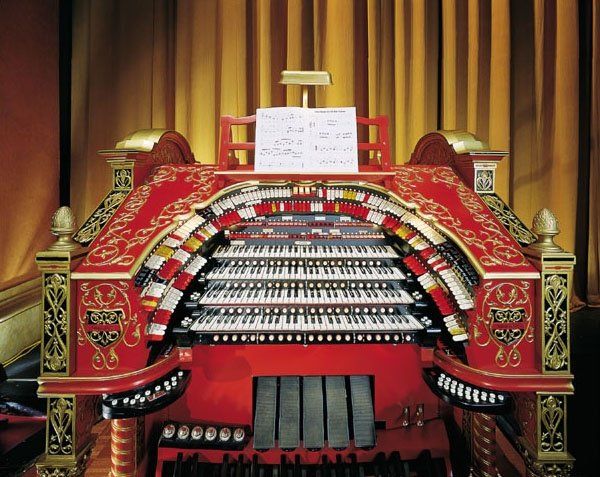
Here I was, standing in front of the majestic center of the theatre. Shaped like an upright piano, it looked like an ostentatious display of keyboards, pedalboard and a myriad of switches and controls. I looked around the theatre and realized that the console matched the décor of the theatre. Red upholstery, red curtains complimented the redness on the console. I went up to the beast and I still could not fathom the magnitude of this beast and its equipment in entirety. The wood on the console was painted white and elaborately carved. I wanted to touch it, but I was afraid that I might wake it up. I looked at Mr. Wallace to get a nod of approval but he had already understood my predicament and patted on my shoulder. With my eyes closed, I could trace out the gold ormolu and the raised gold leaves adorning the imperial sound maker. I sat down on the weird looking bench which was referred to as the dogleg style and started admiring the console. There were colorful taps and stops on the console to stop the flow of air and change the ranks of pipes. I looked at the multiple keyboards facing me in a way that church organ never looked at me. They weren’t flat on my eyes; they weren’t humble enough against man. With each manual, the tilt increased, the ivory too prominent on them. Humility was a common theme in places I used to play, here the trouble was dexterity. Would it follow my commands, or would my hands follow its ever-increasing inclination? Even my feet were at the mercy of the pedals which would change the volume, bringing either a crescendo or trouble with playing. Expression with hands and expression with legs. ‘Play me something Mr. Robert, can you?’, asked Mr. Wallace. I put my fingers on the black and white keys for the first time, but his big, commercial presence was too much for me to play. I remembered Ma saying once, ‘Finesse in your fingers, swell in your feet. Don’t forget, Rob.’ My mind was on the tilt that this piano was giving me, intimidating me, scorning me. I tried to open more shutters to bring a huge wave of sound, but my feet weren’t hitting the pedal firmly.
‘It’s a beast that you are trying to wake up. You need a better prelude’, chuckled Mr. Wallace, “but Mr Jones would train you.”
Chimes, Glockenspiels, Chrysoglott, Vibraphone, Marimba, Mallets. Pride, Dexterity, Finesse, Strength, Intelligence, Perseverance.
I woke up after a dream of Ma playing a hymn on the pipe organ while I was just sitting staring at the birds flying around the empty church.
‘Have you any idea’, he shouted, “what these stops are for”? Despite my experience with pipe organs, I forgot to push in one of the stops during the training.
Something was changing inside me.
‘There’s a petrifying monster looking down on the damsel. I don’t want a contemporary transition. I want caprice in your play.’
I stood on the pavement looking at the people coming in the theatre.
‘These aren’t those long wooden trackers like the one you used in church. They are electric solenoids’, he yelled.
I saw a few gentlemen’s hats blown off, a young wiry boy shoveling snow, a woman approaching a taxi, people in drab coats shielding themselves with umbrellas.
‘Hit that switch and it helps you sustain the notes. It is called the sostenuto switch.’
Wondering about what to play next week, I sipped on a hot cup of coffee while looking at the tracks left on the snow by people. These shapes of human perseverance toiling the soporific whiteness of the manual while the black smoke rose from the tall chimneys of assiduousness and grease. I wondered.
‘More pressure on the foot when you feel that the audience is drifting away. March to death, not a saunter.’
Mr. Jones was certainly meticulous and an authoritarian. I had to learn a lot on how to operate this complex yet beautiful piece of invention.
After a month of training under Mr. Jones for the theatre organ, I had realized that I had to start performing soon otherwise I would be sent back to the mold infested and wooden place, that people called church. I had decided that I was going to play for the next silent movie whatever may be the subject or story. But before that, I had to do something else. Something more important, closer to my ego. I had to write to Hope about my experiences in New York and how I felt before playing for the first time in front of a live audience. I started writing with my unnaturally smooth hands, something which I wonder about all the time while playing the organ.
Dear Hope,
November24th, 1939.
I hope you are doing well, and your uncle is feeling convalescent now. I apologize to you for not writing early as I have been busy with my theater organ training and understanding how theatre music works in big cities. I hope you are keeping in touch with Rudolph as I miss that fat old man. Tell him that I miss his jokes and his bulging belly snooping around in the church. The weather in New York has been harsh and it has been snowing for the past three days. The roads are snow covered, the skies are gloomy at times while people are covered in a variety of coats and wool. I go out at times after the training concludes to walk and see the city but all I see are people running for some reason. I believe they are busy to earn money like me and that is a fair reason to be running around. Mr. Wallace, the theater owner says that I need to learn some of these city walks and talks very quickly as that would help me play good, commercial music. But I don’t understand the remunerative part of music yet and it feels strange. But the bright side of all this is that I have got a very talented and scrupulous mentor in Mr. Jones. He yells at me at times, but I know he is good at heart and wishes the best for me. You should definitely come see the giant theatre organ that is installed at the Wallace Theatre in New York. You know how I used to argue all the time with Rudolph about the old wooden trackers and how ill maintained they were in church. We don’t have any wooden trackers here; everything is operated by an electric solenoid here. I have heard some people calling the theatre organ as a “band in a box”. I can play everything on the console because there are different ranks of pipes installed in a room behind the curtain. I just have to push the stops on the console, and it activates that branch of the ensemble. Mr. Jones has helped me work on my foot skills for the creating different pressures on the wind channel system. I am going to play for the next silent movie as I feel I am quite ready now.
I have been dreaming about Ma a lot since coming to New York. I guess I am just missing people back home and I also get tired a lot after a hard day’s training. I miss you and I would love to show you the whole setup in the theatre and watch a movie together. I am waiting for you to come soon. Please write back to me soon.
Love you,
Robert.
It was dark and cold. The temperatures had gone down a lot in the last few days, and I wasn’t expecting such a huge turnout. My hands and legs were shivering on that weird chair known as the dogleg. I looked around I could see a few faces looking at me with a hint of skepticism. There were a few faces murmuring and their tone seemed indifferent. “A qualm came over me, a horrid nausea and the most deadly shuddering.” Robert Louis Stevenson surely knew how to describe stage fear. I started scratching my head in search of answers but all I could see were the gold leaves designed on the console and all I could hear were distant, vague sentences. Wooden cracks, dust on the rods, hard keys and cobwebs in your face. Those meshed windows, those long pews and the glassed windows on the top. Running bare feet on the old, time stamped rug, I found a vestibule of comfort where people mostly found God. Birds flapping violently against a stolid and unimaginative air compressed inside a wooden box of horizontal and vertical intersections. Birds, did they call me? Or was it those innocent, benignant eyes nailed on the walls? Walls, standing tall rather than being toppled down. No, I did not find faith in the corners of religious sanctum. I found it in something very material, very alive and very much moving. It sounded brilliantly in the empty church. I wasn’t conscious of melody at that time, but it was so beautiful and lyrical, so blithe and warm, so warm and reassuring. I forgot my search for the toy and crossed the pews to find her. It was there, where I first discovered music and learned its rare beauty. The beauty of Ma playing on the church organ which has gladdened me from the that moment…………
Suddenly, there was music. Rapturous!
The movie was titled “Does True Love last True?” featuring a damsel being kidnapped in a hotel and the hero trying to rescue her. I didn’t know how but my fingers went straight to the stops for the 4’ and 8’ tibia and the glockenspiels. There was certainly music flowing through the shutters now. The movie was a form of vaudeville, a type which was strictly abhorred in the church where I lived. A movie without any moral intentions, a superficial motion picture with characters running around at a pace too quick to leave any imprint on the viewers. But there was music to it. Music which was a mixture of moods, pastiche and references. Tibia, a simple wooden, flute shaped instrument was acting as the legs to the dissonant, yet effective glockenspiels. Dissonance which had always haunted me and caused me to doubt myself was celebrated with cheers and roars here.
Trouble began soon. Ms. Tenderheart, the female character got abducted by a group of men. Men, wearing black coats and black hats with visible suspenders. Men who smoked cigars in the lavish lounges of the Grand Palace hotel and men who thought of women as flesh wrapped in ostentatious and enticing clothes. I hit the pedals hard for the snare drums to sound in the ears of the audience as the men beleaguered Tenderheart. Tenderheart petrified and trembling with fear could only evoke in me the emotions of helplessness. I started playing a slow rhythmic section with the piano just using the keys. The iffy in the air was complimented by a slow, iterative tremulant causing the air from the shutters to fluctuate. It felt as Tenderheart was crying, not through her eyes but through her shivering body, sending waves of teetering air through the curtains of the theatre. I could sense the horror in people’s eyes watching this harrowing scene despite the rapid movements of the camera and the fleeting, puppet movements of the vaudeville. Those very same eyes who looked bored of work, tired of the cold wind now seemed excited with horror. But what about our beloved hero, TrueLove? Waltzing in he came, accompanied by my use of 4’ tibia clausa and kinura. I had never used the stop of kinura because it sounded too shallow, too buzzing with a deep sense of tentativeness. The pontifical character of TrueLove dressed in a hat and a coat, marching in the hotel was something to behold. My pedals couldn’t match his pride and the crowd looked at me with an unprecedented chagrin. They wanted their hero to be decorated with music which had loud drums, a bit of English horns and a lot of tibia. Merit of a man at the mercy of the keys coloured black and white. Merit of a man gauged by the length of his hat and tap of his cane. Merit of a man controlled by a trivial player hired from a church. While TrueLove’s haughtiness was applauded, my ego was taken down eye by eye.
“Finesse in your fingers, swell in your feet.” All this while the clarinet solo went on, with my fingers as maudlin as Ma’s symphonies in the evening.
‘Why did you save me from the evil men then?’
‘You were crying for help.’
‘But I thought you loved me True. I thought we were something more. I thought the way my heart beats for you is the same way your heart beats for me. I thought that all the clothing, this hat, this cane, this coat with a strong cologne was a pretense. I thought your haughtiness was just an act. Do you think my tears are fake? Do you think I would want any other man in my life?’
‘Tender, my hands are rough just like my ways. There are certain things that I do, certain attire that I adorn and certain walk that I adopt to get accepted in a world of silk. My smell is mellifluous, but I am not what you think of as.’
‘But True, love is not a something you need to get ready for. It is natural, it is warm, and it is without any deceit. Don’t create these elaborate systems of evasion, be at the mercy of love.’
Rapid movements of my right hand on the second manual while left hand worked with an unknown dexterity at stops and tabs. The tibias changed; the air changed. The glocks came in and out, the xylophone chimed in, the orchestral bells weaved in through while the strings passed by just as the wind outside was blowing off the snow in an inclined way. There was trouble, but Ma was here caressing my hair. There was darkness around me, but I did not have my speech. There were broken hearted people, but I did not possess the panacea. But there was a rapture. There was a parting from the clouds of disappointment, there was a strong current of air flowing through the pipes and there was melody. There was ego which was eroding and there was a ballad. Ballad between notes, ballad between her sobs, ballad between his struts, ballad between their sighs and ballad between us. It was emotion unfurled, impeccably orchestrated and it certainly made sense. I was pulling at all stops and letting all the air come in, the beast taking a huge breath in. The beast, called as the Mighty Wurlitzer in America, was a thing to adore. Slipping down the throat of the might Wurlitzer, with no control over my actions, just the absolute ecstasy of dissonance and engulfed by the medium which carried sound, I hit the sforzando.
Pipes, wooden and rounded, absolute yet kaleidoscopic. Pipes divided into opinions, ranked and voted for yet true to its miniscule length. Pipes, modern or archaic yet necessary to uphold the principles. Pipes, robust, voiced by the supreme builder, working in tandem with the keys and stops, yet surviving the violent roars and swooshes of the simple air. Pipes, in a church or a theater’s disguise, roses wild on my shoulder, in the guile of the river, in the molds of doctrines and sects, in the crumpled edges of the photographs, in the roars of audience and in the cheap violins too, flooding this beautiful window between a sunset and sunrise.
‘Did you hear how he played the music when TrueLove entered the scene? I missed how those vox humanas, drums and loud strings sound. Pretty little boy, but he needs to learn how we like music hitting us hard on our ears, right? Come on then, I am freezing in the cold. Fancy a glass of whisky at Vitolino’s?’
This story is a homage to my love for the beautiful, yet so less celebrated instrument called a theatre organ. Please spare some time by learning about the magnificence and craft of a theatre organ and I am sure that you would be astounded as well. I also apologize for the heavy use of musical jargon used in this story as it was needed to recreate the musical journey. The names in the stories- Robert, Rudolph, Hope and Jones are used for a special purpose. The Rudolph Wurlitzer company was the most well known and prolific manufacturer of the theatre organ and it was commonly called the Mighty Wurlitzer. Robert Hope Jones is considered as the inventor of the theatre organ innovations. A church organist himself, Robert Hope Jones invented the electro pneumatic action, diaphone and the tibia clausa contributing a large part of ingenuity to this incredible piece of machinery. You can review some links and videos that I have attached with this story. Thank you!
https://en.wikipedia.org/wiki/Theatre_organ
https://en.wikipedia.org/wiki/Pipe_organ



 karanvankani
Leave a comment